In the current field of AI workstations and deep learning servers, chassis internal layout design faces unprecedented challenges. On one hand, flagship GPUs like RTX 4090 use massive three-slot or even four-slot cooling solutions, forcing engineers to use PCIe riser cables to laterally relocate graphics cards from motherboard slots. On the other hand, AI inference accelerators like NVIDIA A100 and H100 also require flexible deployment in different chassis positions. This design requirement conflicts with PCIe 5.0 high-speed signal transmission, becoming a common technical pain point across the industry.
1. Physical Causes of PCIe 5.0 Signal Attenuation
The PCIe 5.0 specification increases single-lane transmission rates to 32GT/s, doubling PCIe 4.0's 16GT/s. However, higher signal frequencies mean drastically increased requirements for transmission media. When signals travel through PCIe riser cables, they face several types of attenuation:
Insertion Loss is the primary attenuation source. High-frequency signal energy attenuates exponentially with cable length increase. PCIe 5.0 standards require total channel insertion loss not to exceed 28dB at 16GHz. For a high-quality 10cm PCIe 5.0 riser cable, insertion loss is approximately 3-5dB—seemingly small, but combined with connector impedance and PCB trace losses, it can easily approach or exceed standard limits.
Impedance Mismatch is another critical issue. PCIe standards specify differential impedance of 85Ω±15%. During high-speed signal transmission, any impedance discontinuity causes signal reflection. Reflected signals superimposed on original signals generate ISI (Inter-Symbol Interference), which can completely close the eye diagram at severe levels, preventing the receiver from correctly sampling. As speeds increase, impedance tolerance requirements become more stringent, placing extremely high demands on cable and connector manufacturing processes.
Crosstalk becomes particularly prominent in high-density routing environments. With limited spacing between GPU and other high-speed device traces inside the chassis, electromagnetic coupling between adjacent signal lines causes crosstalk. Although PCIe 5.0's PAM-2 encoding has some tolerance for crosstalk, effective shielding remains essential for long-distance transmission.
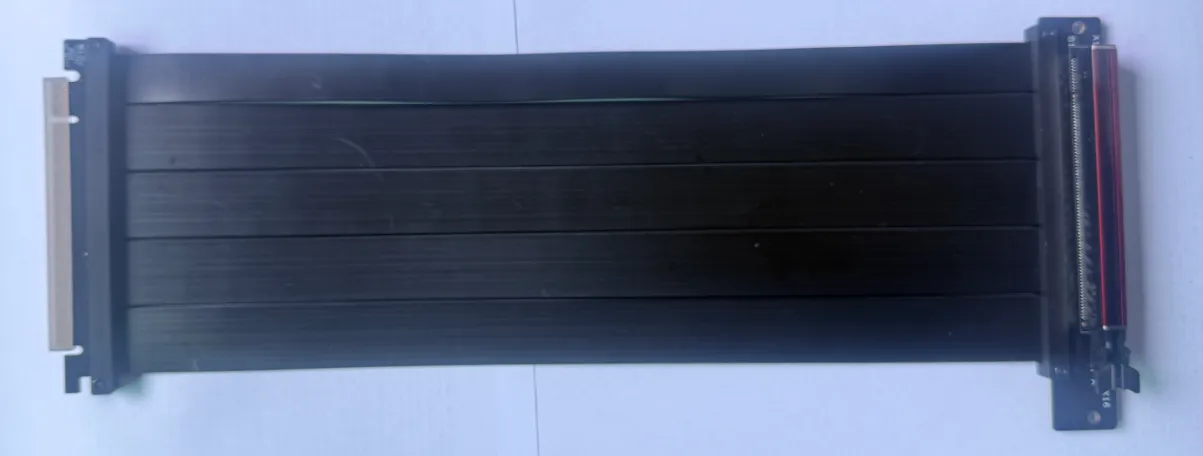
2. Typical Application Scenarios in Chassis Design
In practical workstation design, PCIe riser cable usage mainly concentrates on the following scenarios:
Vertical to Horizontal Layout: This is the most common application. Motherboard PCIe slots are vertically oriented, while large graphics cards or accelerator cards need horizontal placement to save vertical space. Engineers typically use 10-15cm PCIe 5.0 riser cables to achieve this conversion. However, the challenge lies in cables crossing the chassis bottom, potentially affected by power supply thermal airflow—elevated temperatures further exacerbate signal attenuation.
Dual-Card Interconnect (SLI/NVLink) Layout: In workstations requiring dual-card parallel computing, the distance between two graphics cards may exceed native motherboard slot spacing. PCIe riser cables are needed for bridging, but dual-card scenarios impose more stringent requirements on signal synchronization and timing.
Remote PCIe Layout: Some high-end workstations adopt the remote PCIe board concept, extending slots to chassis sidewalls or front panels via high-speed cables to support hot-swapping or special-form-factor expansion cards. This approach demands superior mechanical strength and electrical performance from cables.
3. YZMU's Solutions
Addressing these pain points, YZMU has launched a series of high-performance PCIe 5.0 riser cable products through years of R&D accumulation, achieving multiple innovative breakthroughs in signal integrity design:
Material Innovation: We employ 30AWG silver-plated copper cores as signal transmission media. Silver-plated copper wires leverage the skin effect to significantly reduce resistance loss at 16GHz high frequencies. Compared to standard tin-plated copper wires, silver-plated copper wire DC resistance decreases approximately 15%, with AC impedance reduced over 20%—critical for overall riser cable performance improvement.
Structural Design: Cables adopt a unique "Air-Core" design philosophy that maximizes media loss reduction while ensuring adequate mechanical strength. The air cavity filled around the wire core effectively lowers the cable's equivalent dielectric constant from typical 2.3 to approximately 1.5, improving signal transmission speed by nearly 10%.
Shielding Process: Each differential signal pair utilizes independent dual-layer shielding structure—an inner aluminum foil layer plus outer tin-plated copper braid. This design suppresses inter-channel crosstalk below -40dB, fully meeting PCIe 5.0 EMC requirements.
Connector Optimization: We collaborated with international top-tier connector manufacturers to develop dedicated PCIe 5.0 connectors. Contacts employ gold-on-gold design with stable contact resistance below 5mΩ. Connector housings feature full shielding design, effectively preventing EMI radiation leakage.
4. Selection and Design Recommendations
When selecting PCIe riser cables for AI workstations, engineers need to comprehensively consider the following factors:
Length Selection: Within performance允许的范围内,应优先选择较短的延长线。In performance-allowable ranges, shorter riser cables should be prioritized. Signal attenuation correlates approximately linearly with length—every 1cm reduction means performance improvement. Our test data shows that under identical conditions, 8cm riser cable eye diagram height is approximately 15% higher than 15cm riser cables.
Bend Radius: Cables must avoid sharp bends during installation. PCIe 5.0 riser cable minimum bend radius is typically 4-6 times the cable diameter. Bending is strictly prohibited within 2cm of connector roots, as it causes internal dielectric structure damage affecting impedance continuity.
Thermal Management: Internal chassis temperature significantly impacts riser cable performance. High temperatures increase conductor resistance and reduce signal amplitude. We recommend arranging riser cables in good thermal airflow paths, avoiding proximity to power supply or GPU cooler exhaust vents.
Need Professional Support?
YZMU offers free sample testing and technical consultation services. Our engineering team can help evaluate chassis layout solutions, optimize PCIe riser cable selection and routing design, ensuring optimal system performance.
Contact Technical Advisor